Bhushan Nemade
·
The expectations from product managers are changing. As engineering teams move faster with AI, PMs are expected to keep pace: turning ideas into clear requirements more quickly, understanding user needs sooner, and making decisions about what to build. But in the current product workflow, much of the PMs' time is spent on coordination, moving context across teams, tools, and documentation. Leaving less time for the decisions that actually shape the product.
In this blog, we will look at how a shared product workflow between AI Agents and teams helps PMs move faster and keep pace with engineering teams.
The Product Workflow
Product work follows a loop; some teams define it explicitly, while others follow it without naming it.

The Signals become initiatives. Initiatives become plans. Plans move into execution. Execution creates shipped work, updates, launch assets, and new signals. Then the team learns, and the loop starts again.
The Current Product Workflow Is Too Manual For AI Era
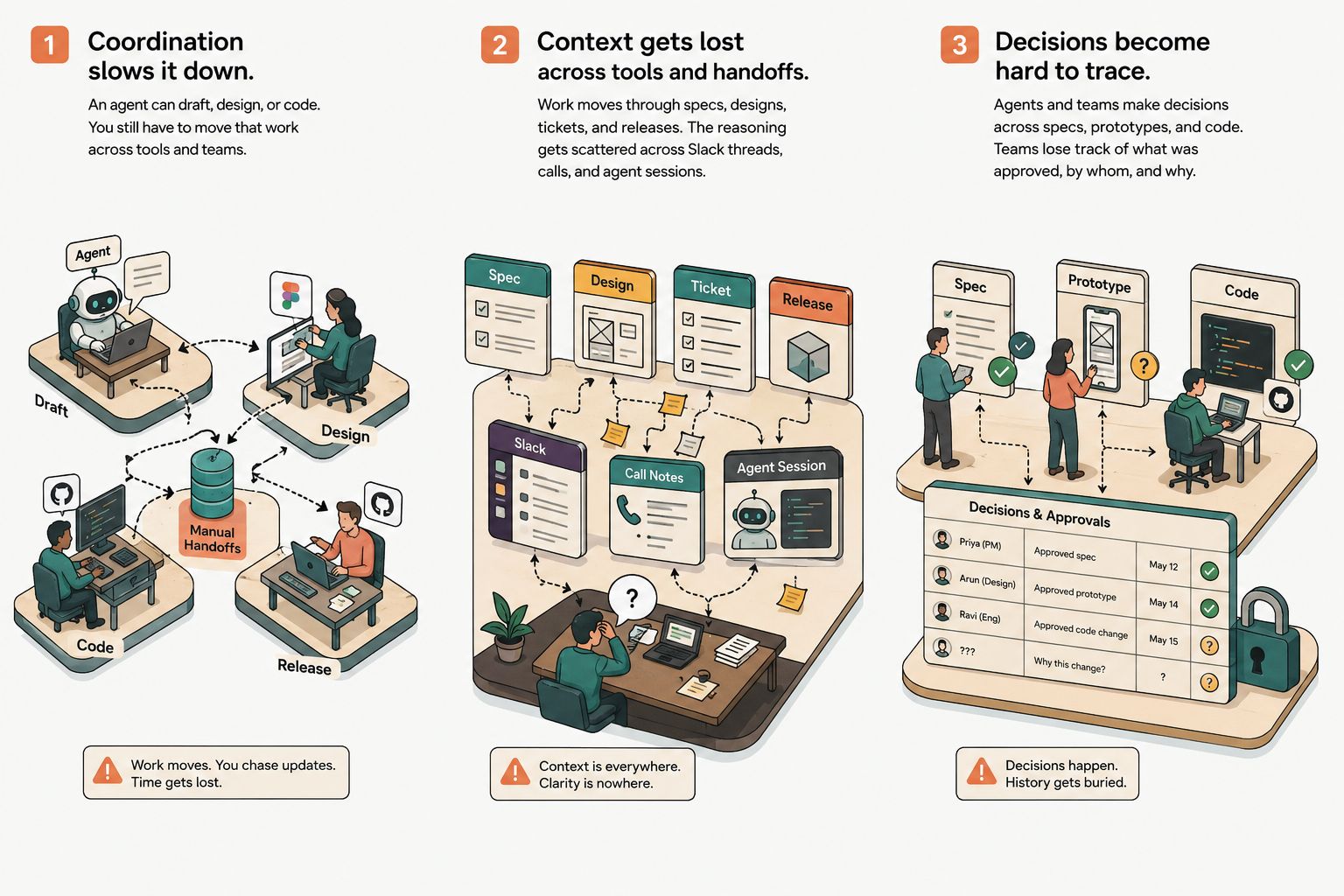
The current product workflow processes depend on manual coordination. PMs have to collect customer feedback, sales notes, support issues, and product analytics all from different tools. Then turn all of that into themes, initiatives, requirements, specs, tickets, updates, and release notes.
Even with AI tools, workflows remain slow. The reason: most AI tools speed up individual tasks, not the workflow. They draft a PRD, summarize a call, generate user stories, or analyze feedback. But product work does not move as isolated tasks. It moves across tools, processes, and people.
The Shared Workflow Between PMs, Teams, and AI Agents
The new product workflow is not a completely new framework; it's the same product workflow reimagined – how the work moves between stages, teams, and tools with AI Agents.
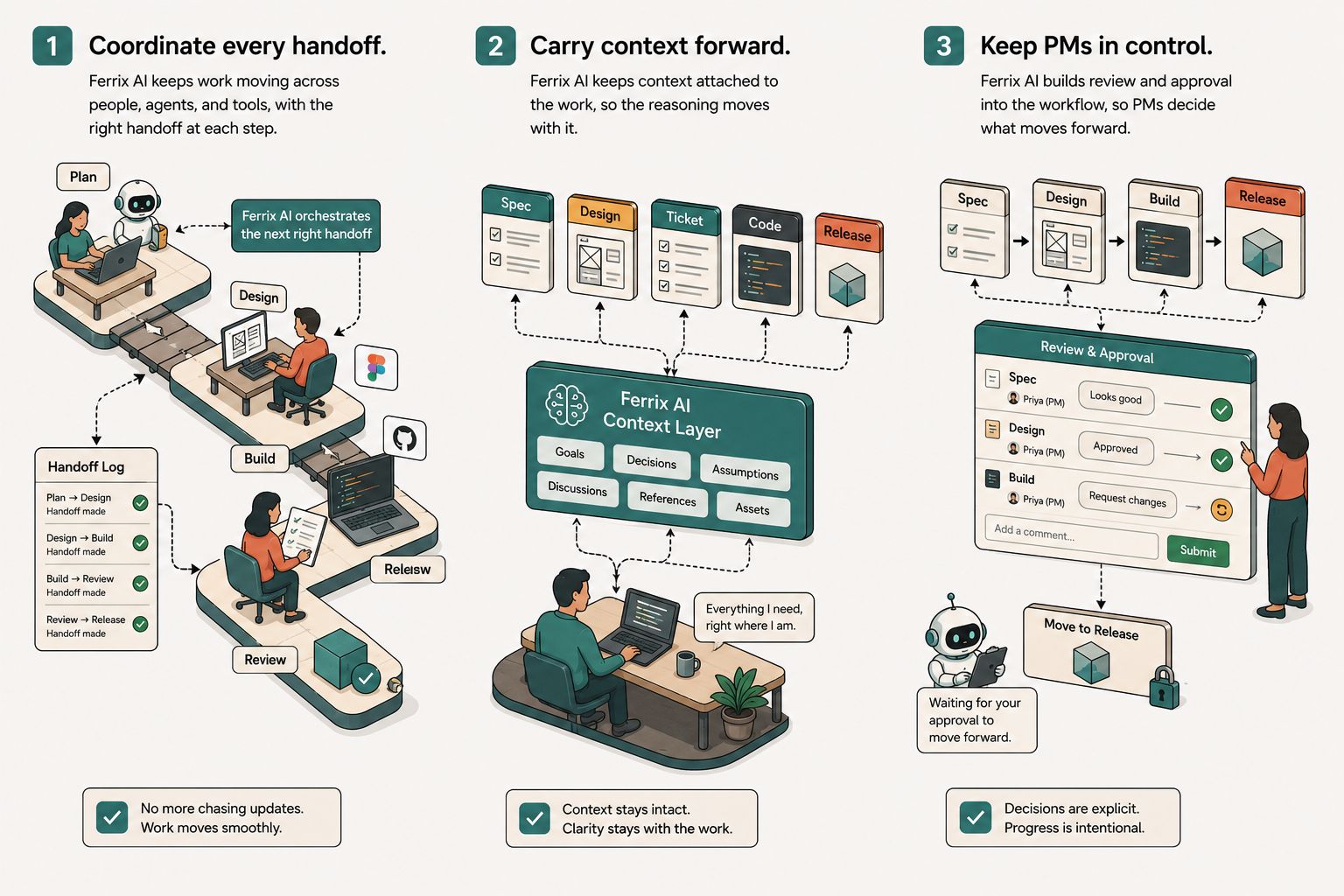
In a shared workflow, product managers, designers, engineers, and AI Agents work toward the same goal with the same context.
AI Agents take ownership of repetitive tasks, maintain context across stages, and handle much of the coordination required to keep work moving.
PMs continue to define goals, make trade-offs, and drive the decisions that matter.
Let's understand better with an example:
A product team sees repeated signals from customer channels: support tickets, sales calls, customer success notes, feedback forms, and product analytics. An agent connects those signals to one initiative and keeps the evidence attached.
The PM reviews the initiative, defines the goal, and makes decisions on priority, constraints, risks, and tradeoffs. Those decisions move forward with the work.
When the initiative moves to design, the same context goes with it. Designers see the customer problem, goal, constraints, and decisions already made.
Once product and design are aligned, the context moves to engineering. Engineers see the scope, user flows, open questions, and tradeoffs behind the feature.
After release, the loop closes with customers and stakeholders. The team can explain what changed, why it changed, and how it connects back to the original signals.
The agent keeps context moving across the workflow. PMs and teams keep control of the decisions.
Challenges With The Shared Product Workflow
A shared workflow with AI Agents helps to move work faster, but it also introduces new risks:
Quality degradation: Agents can hallucinate or drift from the original product goal. A small wrong assumption by an agent can move from a summary into a PRD, then into tickets, and later into product.
Lack of integration: If agents do not connect and work across the tools where product work happens, the workflow gets disrupted.
Security and data privacy: The workflow and agents need strict and well-defined boundaries because product workflows include customer data, roadmap plans, revenue context, competitive notes, and internal strategy.
Sharing across teams: An agent running only on one PM’s machine may help that person move faster, but the team does not inherit the context. It creates private speed, not shared workflow improvement.
Ownership: When an agent drafts a requirement, summarizes feedback, or suggests a scope change, the team still needs to know who reviewed it and who approved it.
Preserving decision trail: The workflow has to preserve the decision trail and institutional knowledge. Teams need to know why something was prioritized, what evidence shaped it, what tradeoffs were accepted, and what the agent learned along the way.
How To Mitigate These Risks
Context that keeps agents grounded. Agents should work from approved product goals, customer evidence, roadmap priorities, scope decisions, constraints, and open assumptions. This reduces hallucination, goal drift, and disconnected outputs.
Review hooks keep humans in control. They should be enforced inside the workflow. Agent output should require approval before it becomes a PRD, ticket, scope change, roadmap update, launch message, or customer-facing communication.
Policy governance keeps the workflow safe. Teams need rules for data access, storage, permissions, ownership, and decision records. This protects customer data, prevents private agent silos, and preserves the decision trail.
Ferrix AI
That is what we are building at Ferrix AI: a shared product management workflow for teams and AI Agents.
With Ferrix AI, teams can replicate their existing product workflow and run it with agents. It becomes a centralized workspace across product, design, and engineering, where agents handle repetitive work.
Since this work happens inside a connected workflow, agents carry context across stages. Review hooks are enforced at every stage, so generated work does not become product direction until the right owner approves it.
Teams also get guardrails around data access, storage, and ownership, while preserving the decision trail.
PMs, designers, and engineers use the same workspace to review outputs, make decisions, and move work forward. When implementation begins, the context built during discovery and planning can be passed to coding agents through Ferrix AI’s MCP server.
This reduces manual coordination for product managers while keeping decisions and ownership with the team.

