Bhushan Nemade
·
AI has made software development faster. Engineers can generate code, debug issues, and automate many repetitive tasks. The impact on product management has been less obvious.
The reason is simple: product work is mostly coordination work.
Product managers spend their time collecting feedback, prioritizing problems, aligning teams, documenting decisions, and making sure context survives as work moves from discovery to delivery. AI copilots help with individual tasks, but much of the coordination still falls on the PM.
Why Most AI Copilots Fail PMs
Product work follows a loop; some teams define it explicitly, while others follow it without naming it.
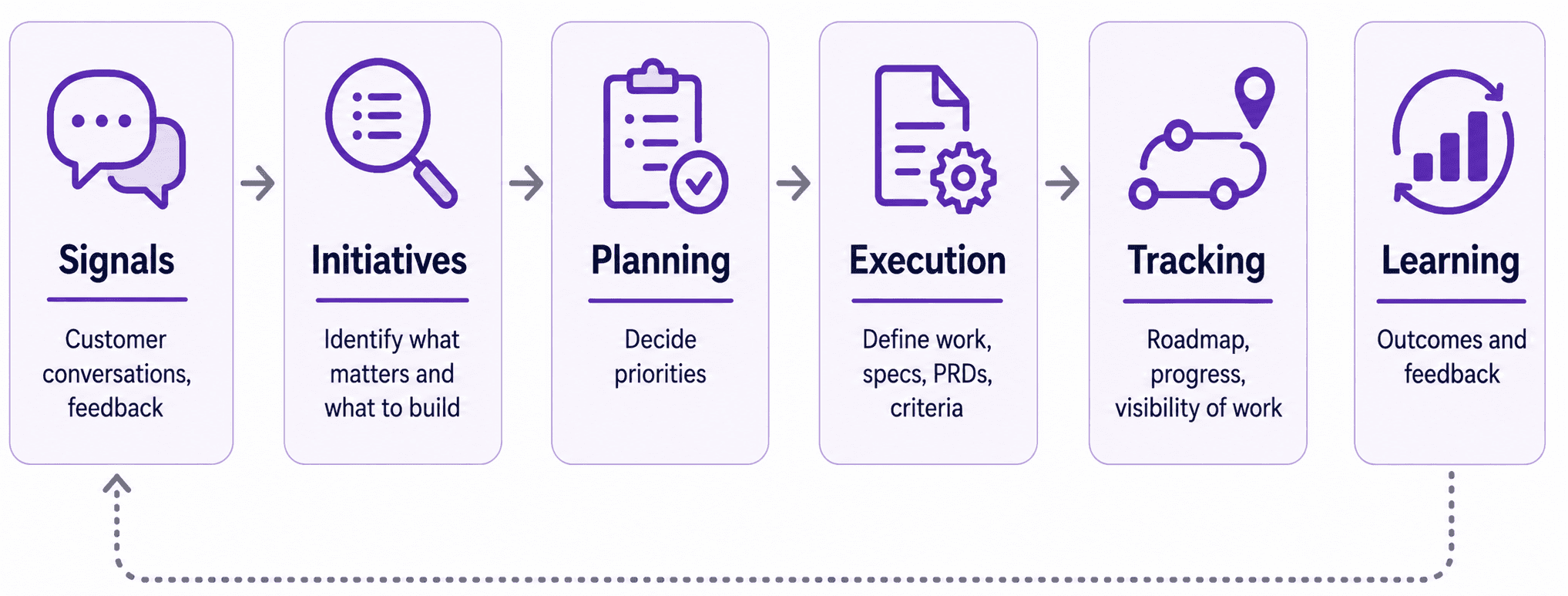
Customer feedback leads to ideas. Ideas become initiatives. Initiatives turn into plans and specifications. Teams ship features, generate new artifacts, and learn from the results.
AI copilots are useful because they speed up specific tasks. They can summarize customer calls, analyze research, draft PRDs, or write specifications. These capabilities save time, but they only optimize individual steps.
The work between those steps still depends on the product manager.
For example, feedback collected during discovery influences prioritization. Prioritization affects requirements. Requirements introduce constraints that engineers need to understand later. Since most AI tools only see the context provided to them, PMs end up repeatedly gathering information and transferring it from one tool to another.
As a result, the tools accelerate tasks, but the PM remains responsible for maintaining continuity across the workflow.
Running Product Work Through a Shared Workflow
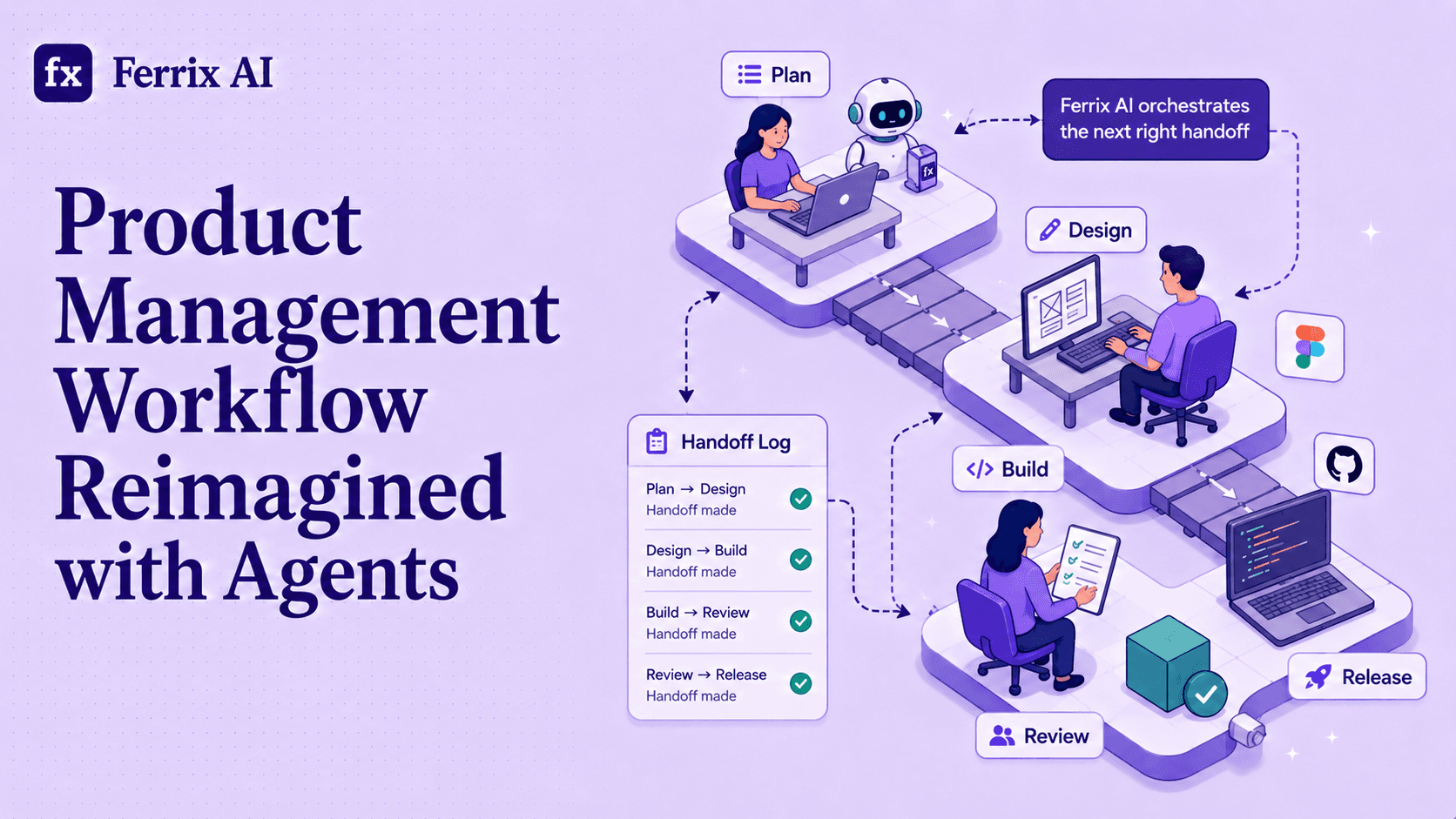
Product teams need more than a collection of AI tools. They need a shared workflow where both teams and AI agents can operate within.
In such a system, the product team, designers, engineers, and the AI agent work against the same process and with the same context. The agents take ownership of repetitive tasks, maintain context across stages, and handle much of the coordination required to keep work moving.
The PMs still define goals, make trade-offs, and drive important decisions.
Ferrix AI
Ferrix AI is an agentic platform that lets product teams replicate their existing product workflow and run it with AI agents.
AI Agents handle repetitive product work, including discovery, validation, PRD, spec writing, and progress tracking. Since this work happens inside a connected workflow, agents reuse context from earlier stages instead of the PM providing context again.
PMs, designers, and engineers use the same workspace to review outputs, make decisions, and move work forward. When implementation begins, the context built during discovery and planning can be passed to coding agents through Ferrix AI's MCP server.
This reduces manual coordination for product managers while keeping decisions and ownership with the team.