Bhushan Nemade
·
TL;DR
Customer feedback, sales insights, support conversations, and roadmap priorities often remain fragmented across tools. Turning scattered inputs into a clear PRD takes a lot of manual effort.
Ferrix AI agents help convert this fragmented context into validated product opportunities.
The PRD Agent turns those opportunities into clear, execution-ready requirements grounded in evidence.
This helps PMs move from documentation work to higher-value decisions around scope, tradeoffs, and product direction.
Product teams work with more inputs than ever: customer feedback, sales notes, support conversations, usage patterns, and roadmap priorities. Turning these inputs into clear product requirements is more about synthesizing the context and identifying opportunities.
As priorities become clearer, product managers need to structure decisions into specifications that engineering can execute. That includes defining requirements, documenting edge cases, aligning on scope, and creating acceptance criteria. Ferrix AI’s PRD Agent is designed around this, helping teams move from scattered product context to structured, execution-ready PRDs with greater consistency and speed.
What is a Product Requirement Document (PRD)?
A Product Requirements Document (PRD) is a product artifact that defines the product problem, user need, business context, scope, and success criteria. It acts as a shared reference for product, engineering, design, and other stakeholders during the development process, ensuring everyone is aligned on what needs to be built.
What Makes Writing PRD Difficult?
Writing a PRD is difficult because most of the real work happens before any writing even begins. PMs have to gather scattered customer feedback, internal conversations, and raw data, then turn that into coherent requirements that reflect what users need. Those requirements have to be checked against business goals, stakeholder priorities, and resource constraints.
Once the scope is agreed on, the PM has to decide what stays in, what gets cut, how much detail each section needs, and what success looks like in measurable terms. Too little detail and engineers make wrong assumptions. Too much, and the document becomes a burden nobody reads. A single missing detail or overlooked edge case can delay the team, create rework, and lead to a product that solves the wrong problem.
How Ferrix PRD Agent Generates Perfect PRD for You
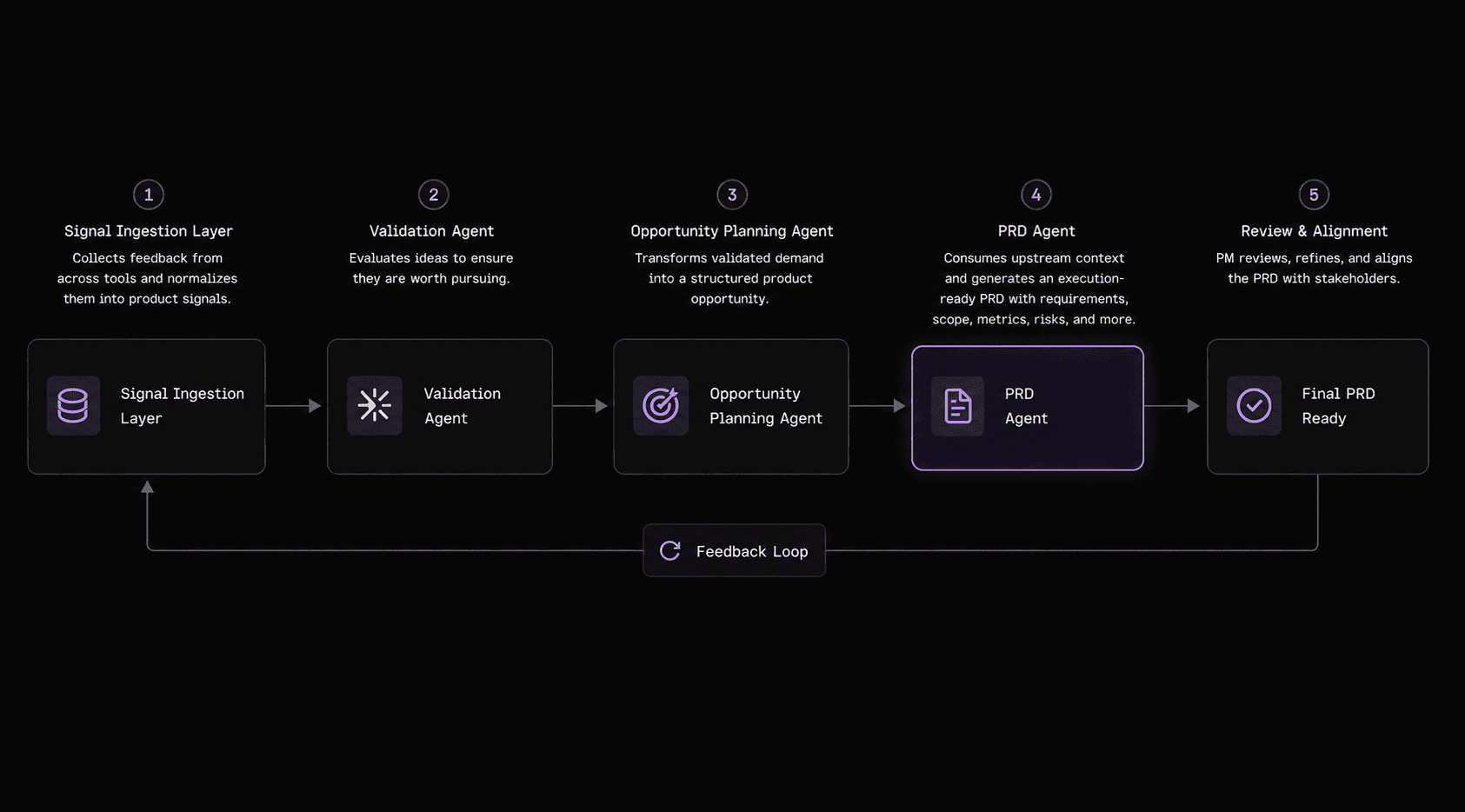
Before the PRD Agent starts drafting, Ferrix AI prepares the product context through a series of connected agents.
The Signal Ingestion Layer first pulls fragmented customer feedback and conversations from different tools and normalizes them into structured product signals.
The Validation Agent consumes normalised signals from the ingestion layer and determines whether a product idea is truly worth pursuing.
Once the idea is validated, the Opportunity Planning Agent transforms raw demand into a structured product opportunity.
The PRD Agent takes the prepared context and drafts the PRD with the problem, target users, goals, success metrics, scope, risks, dependencies, and open questions.
Because the PRD is built on validated customer demand, business priorities, roadmap direction, and known constraints. The product, design, and engineering teams can start from the same understanding and move faster toward execution.
You, as a PM, begin with a structured, evidence-backed PRD draft. This reduces your time spent on gathering context, connecting scattered customer and business signals, and writing documentation from scratch, allowing you to focus more on decision-making, strategy, stakeholder alignment, and execution.
Quick Comparison: AI Copilots vs Ferrix PRD Agent
AI Copilots | Ferrix PRD Agent | |
|---|---|---|
Starting point | Starts from the prompt given by the PM. | Starts from a validated product context already gathered by upstream Ferrix AI agents. |
Context | PM has to add customer notes, business context, and constraints manually. | Uses signals from customer conversations, CRM, support, roadmap, analytics, and engineering tools |
Output | Generates a useful first draft, but may miss product-specific details. | Generates a PRD grounded in customer evidence, priorities, risks, and scope. |
PM effort | PM spends more time preparing inputs and checking gaps. | PM spends more time reviewing, refining, and making product decisions. |
Conclusion
A good PRD needs more than a well-written draft. It needs the right context, clear scope, and evidence behind the decision. Ferrix AI’s PRD agent helps PMs bring that together faster, so teams can move from product signals to execution-ready artifacts with less manual work.