Bhushan Nemade
·
Product work spans across customer calls, feedback tools, analytics, docs, tickets, Slack threads, roadmap discussions, and competitor updates. PMs have to collect this context, connect it, analyze it, and decide what to build next. That takes time, as AI-assisted engineering teams get faster, making product teams the bottleneck.
A lot of this work is repetitive and can be delegated to AI with the right guardrails. But most AI copilots and general-purpose agents are not designed for product workflows. They are reactive, depend on prompts, and require PMs to manually provide context. They also do not work well across the scattered tools where product work actually happens.
Ferrix AI Agents for Product Managers
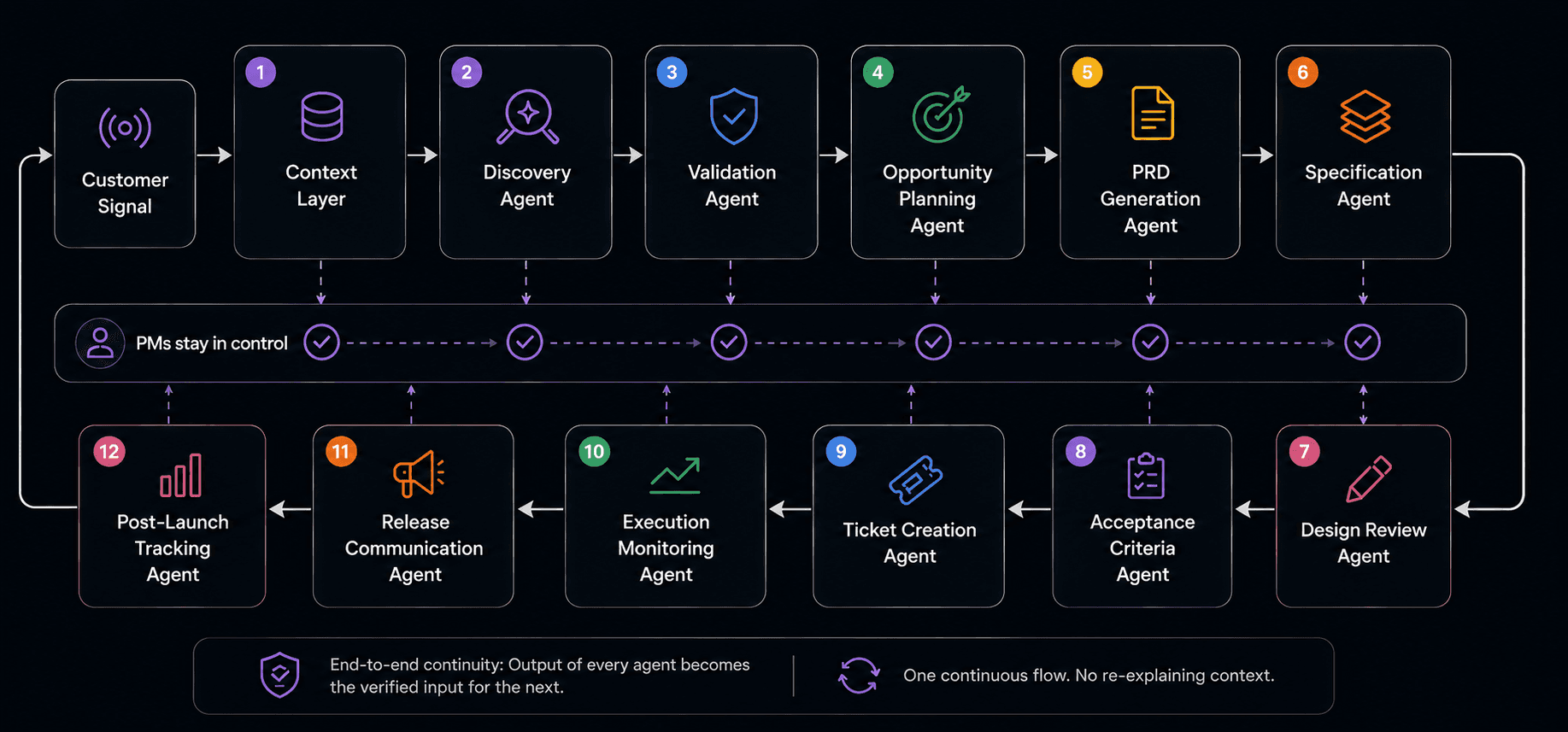
Ferrix AI Agents work with organizational context across customers, product usage, business priorities, roadmap direction, and execution signals. Instead of relying on isolated prompts, the agents continuously use this shared context to organize information, surface priorities, prepare artifacts, and move work forward with calibrated autonomy. The workflows are designed with built-in guardrails, PMs review, approve, and guide important decisions while agents handle repetitive coordination and operational work.
Context Layer
The Context Layer gathers scattered customer feedback and conversations from different sources and normalizes them into structured product signals. It gives PMs a clean, organized view of customer needs so they can review the output, add missing context, and steer product decisions faster.
Product Discovery Agent
The Product Discovery Agent analyzes customer feedback, sales calls, support tickets, Slack discussions, CRM notes, market signals, competitor mentions, and product analytics to identify themes, repeated problems, affected customers, supporting evidence, urgency, and suggested opportunities.
Product Validation Agent
The Product Validation Agent evaluates product ideas across request frequency, problem severity, affected segments, CRM revenue impact, and product usage metrics. It generates a Validation Brief that helps PMs understand whether an idea is backed by real customer demand, business value, and strategic alignment.
Opportunity Planning Agent
Opportunity Planning Agent analyzes the Validation Brief, customer segments, business impact, roadmap themes, constraints, and solution options to frame the right product opportunity. It generates an Opportunity Brief with the target segment, product bet, priority, possible solutions, dependencies, and recommended path.
PRD Generation Agent
The PRD Generation Agent converts PM-approved opportunities into execution-ready PRDs. It synthesizes the Validation Brief, Opportunity Brief, strategy docs, roadmap context, customer evidence, and constraints to define the problem, target users, goals, non-goals, success metrics, high-level scope, risks, and open questions.
Product Specification Agent
The Product Specification Agent transforms the approved PRD into detailed, execution-ready product specifications. It combines the PRD with user research, design context, existing product behavior, and engineering constraints to generate JTBDs, user journeys, user flows, functional requirements, and edge cases.
Design Feedback Agent
The Design Feedback Agent reviews designs against the PRD and product specification. It identifies missing flows and states, highlights UX gaps, captures open decisions, and recommends changes so product and design teams can stay aligned before development moves forward.
Acceptance Criteria Agent
The Acceptance Criteria Agent analyzes the context and inputs from previous Ferrix agents to generate the acceptance criteria, UAT scenarios, and QA brief. As PMs, you get clear validation criteria and test scenarios before development begins.
Ticket Creation Agent
The Ticket Creation Agent generates a structured Ticket Pack containing epics, stories, tasks, bugs, descriptions, acceptance criteria, linked requirements, dependencies, and suggested owners. It can also push these tickets into tools like Jira and Linear, where teams track execution work.
Execution Intelligence Agent
The Execution Intelligence Agent analyzes ongoing development activity and generates an Execution Brief. It captures current work status, blockers, scope changes, at-risk items, and recommended PM actions, giving PMs continuous visibility into execution progress.
Release Communication Agent
The Release Communication Agent uses the latest execution status to create a release communication pack. It generates stakeholder updates, customer updates, sales and support notes, release notes, risk messaging, and recommended next communication actions for different audiences.
Post-Launch Monitoring Agent
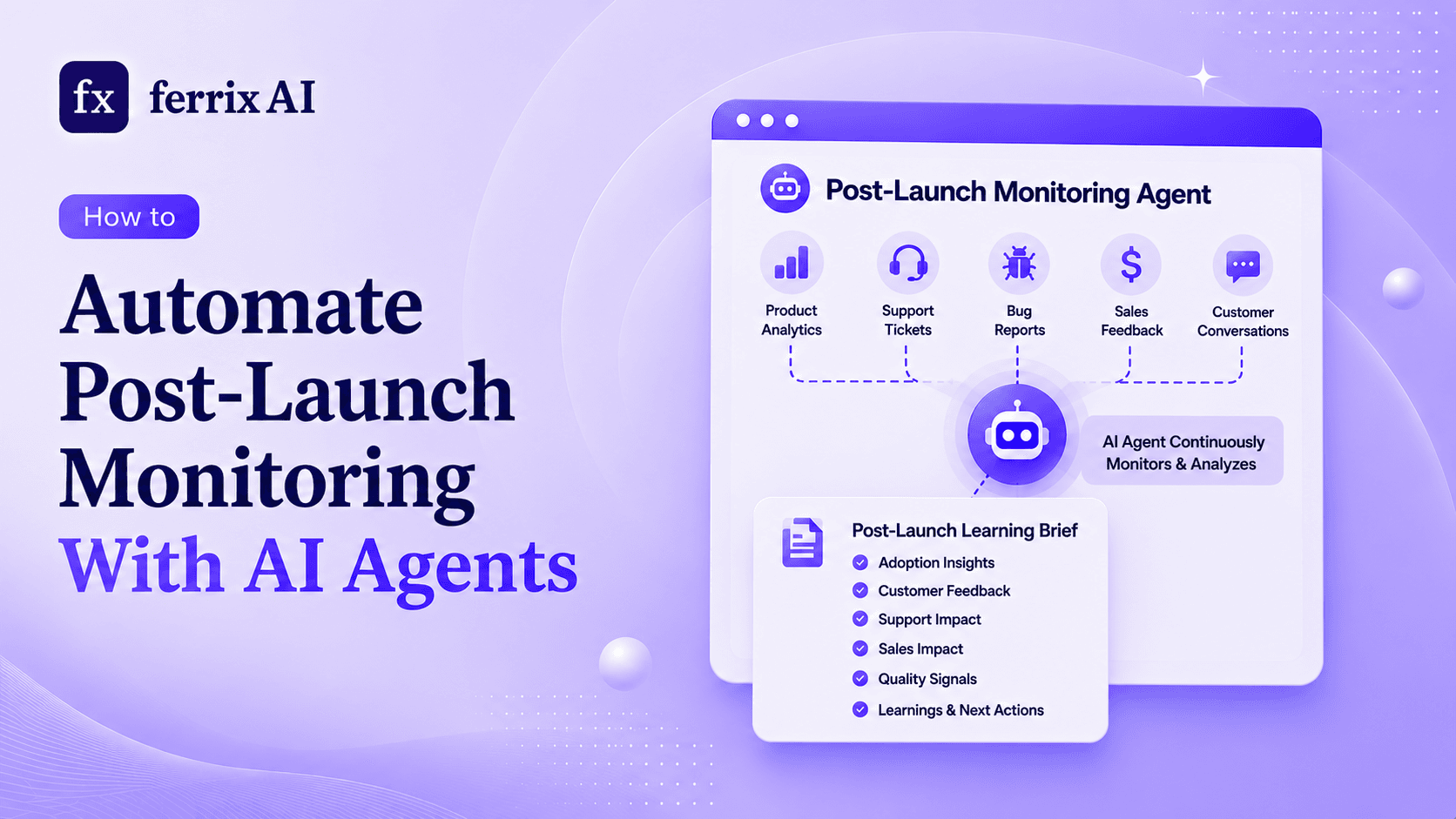
The Post-Launch Monitoring Agent tracks shipped features against their original goals and customer expectations. It analyzes launch context, success metrics, product usage, support tickets, bugs, sales feedback, and customer signals to generate a Post-launch Learning Brief with adoption insights, quality signals, customer feedback, key learnings, likely issues, and recommended next actions.
Ferrix AI Agents are designed to work as a connected product workflow, not as separate one-off tools. Each agent takes context from the previous agent, adds structure, and passes forward a clearer artifact for the next decision or action, while PMs stay in control of decisions at every stage.
The Human-in-the-Loop and Calibrated Autonomy
Ferrix AI Agents are not designed to make every product decision on their own. They are designed to understand which actions can be handled automatically, which actions need PM confirmation, and which decisions should be escalated.
The autonomy of each agent is calibrated based on three factors: risk, reversibility, and earned trust. Low-risk and reversible work, such as organizing feedback, preparing summaries, or drafting artifacts, can move faster. Higher-impact decisions, such as approving an opportunity, finalizing a PRD, changing scope, or sending release communication, require human review.
This keeps PMs in control without making them manage every small step. Agents handle the repetitive coordination work, while PMs review evidence, make tradeoffs, approve key decisions, and guide the product direction.
Autonomy also changes over time. If PMs consistently approve certain actions with few edits, the system can reduce unnecessary confirmations for that workflow. If PMs frequently correct or reverse an action, the system intervenes earlier and asks for review. Trust is built per workflow and action type, not applied blindly across everything.
Vision
AI-assisted engineering teams can already ship code faster than product teams can decide what to build. That gap will widen.
Ferrix is built on a simple premise: the best PMs should spend their time on judgment, not coordination. When gathering signals, drafting docs, writing tickets, and tracking execution are handled by agents, PMs get back the hours they need to talk to customers, think clearly, and make better decisions.
The goal is not to automate product management. It is to give every PM the leverage to do their best work.