Bhushan Nemade
·
Cross-functional product teams move fast only when product, design, engineering, and go-to-market teams work from shared context. In many organizations, that context gets scattered across tools, handoffs, meetings, and unclear ownership.
The result is slow decisions, lost information, and PMs spending more time coordinating work than shaping the product.
A better product development workflow helps every team understand what is being built, why it matters, what changed, who approved it, and what the next team needs to move forward.
In this blog, we will look at where product development workflows break, why they break, and how AI agents can help teams build a better workflow.
Why the Product Development Workflow Breaks
Product development breaks when context does not move with the work.
A requirement may be clear to the PM, but by the time it reaches design or engineering, the reasoning behind it is often missing. Teams know what needs to be built, but not always why it matters, what trade-offs were made, or what problem the feature is supposed to solve.
Each handoff removes part of the story.
Design loses the original customer context. Engineering tickets list tasks but miss the product intent. Scope changes during implementation, but design, QA, GTM, and sales do not get the updated context. QA tests whether the feature works, but not whether it solves the user problem. Launch teams get the final feature details, but not the reasoning behind what changed and why.
When coordination breaks:
Teams lose shared context
Decisions become hard to trace
Ownership gaps appear
Handoffs create rework
AI becomes another silo instead of a shared advantage
Follow-up and Status Updates Are Not Enough
Teams often try to fix workflow with more meetings, more check-ins, and more status updates. It only adds another layer of coordination.
Meetings can surface blockers; they do not always preserve context. A decision may be discussed in a call; the reasoning, trade-offs, and owner often disappear after the meeting ends. Status updates can say what changed, but not always why it changed or what another team needs to do next.
What a Better Cross-Functional Workflow Looks Like
A better product development workflow keeps execution connected from requirement to release.
At every stage, the workflow should make five things clear:
What is being built: The feature, flow, fix, or improvement the team is working on.
Why it matters: The user problem, business goal, or product outcome behind the work.
What changed from the original scope: Any updates to requirements, design, timelines, edge cases, or technical approach.
Who approved the change: The person responsible for reviewing and accepting the decision.
What the next team needs to act: The exact context design, engineering, QA, GTM, or sales needs to move forward.
When this is clear, teams spend less time asking for missing context and more time executing. The workflow does not just track tasks. It keeps the product goal connected to the work until the feature is shipped and measured. An agent continuously observes the workflow, navigates obstacles, and advances the next steps.
Shared Product Development Workflow With AI Agents
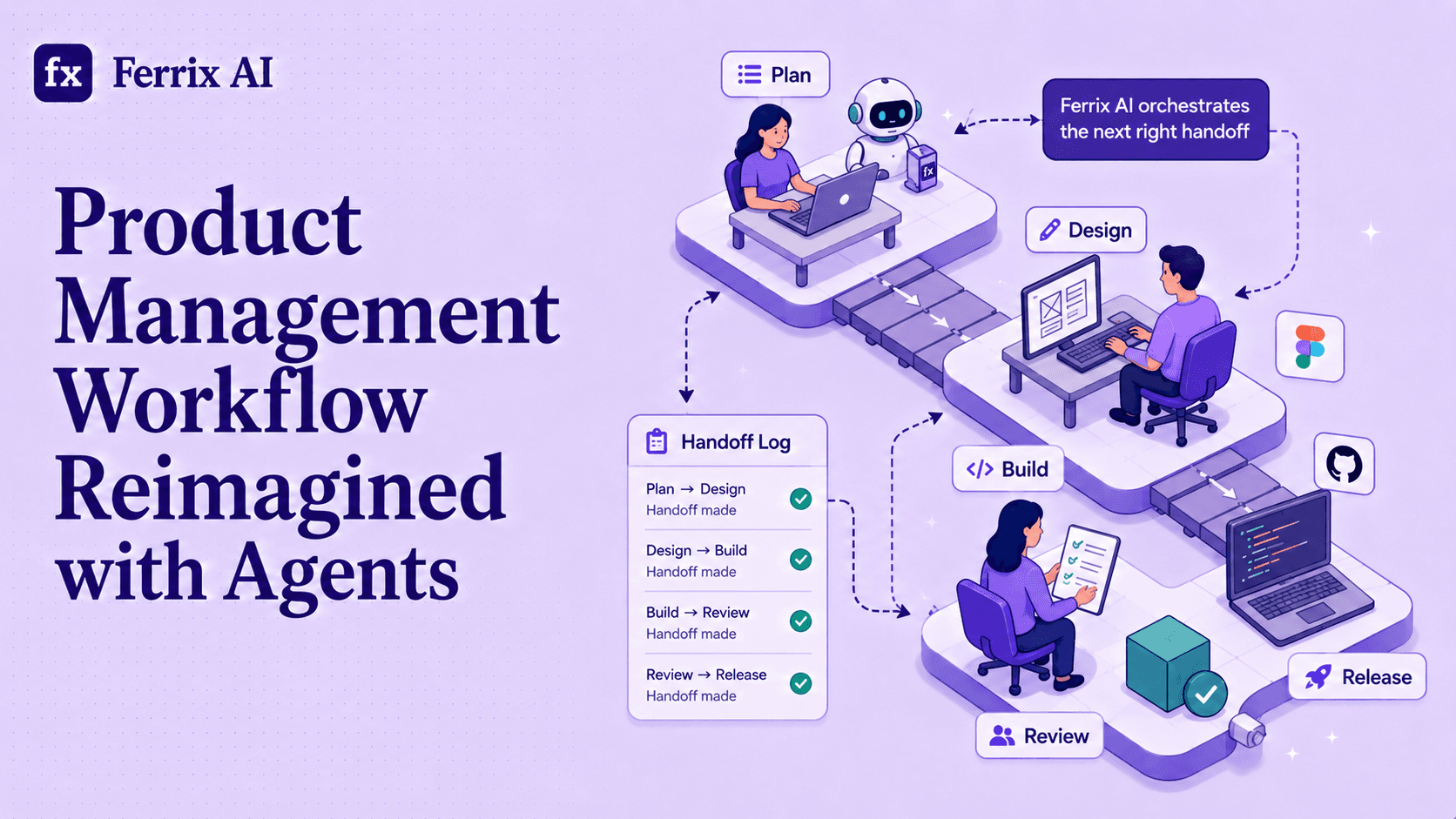
In a shared product workflow, teams and AI agents work together to move faster and stay connected across stages, teams, and tools.
AI agents take ownership of repetitive tasks, maintain context across stages, and handle much of the coordination needed to keep work moving.
PMs and teams continue to define goals, make trade-offs, and drive the decisions that matter.
Let’s understand how this works practically through an example:
A PM approves an onboarding improvement with a clear goal: reduce drop-off during account setup.
The agent turns the approved scope into a design brief with the reasoning behind it. Designers use it to create the onboarding flow with the right goal, constraints, and customer context.
Once the design is approved, the agent turns it into engineering tickets with user stories, acceptance criteria, design links, and edge cases.
During development, engineering finds a dependency. The agent captures the change, updates the scope, and informs PM, design, and QA.
QA gets test cases linked to the original goal, so they test both the feature and the intended outcome.
GTM gets launch notes based on what actually shipped, what changed, and why it matters to users.
After release, product metrics and customer feedback are linked back to the original goal.
The agent keeps context moving across teams. The team still owns the decisions.
Challenges With a Shared Product Development Workflow
The shared workflow with AI agents comes with some challenges like:
Quality degradation: Agents can hallucinate or drift from the original product goal. A small wrong assumption by an agent can move from a summary into a PRD, then into tickets, and later into product.
Lack of integration: If agents do not connect and work across the tools where product work happens, the workflow gets disrupted.
Security and data privacy: The workflow and agents need strict and well-defined boundaries because workflows include customer data, roadmap plans, revenue context, competitive notes, and internal strategy.
Ownership: When an agent drafts a requirement, summarizes feedback, or suggests a scope change, the team still needs to know who reviewed it and who approved it.
How Ferrix AI Helps Cross-Functional Product Teams
Ferrix AI helps cross-functional product teams run their product development workflow with AI agents while keeping PMs and team owners in control.
It works across the stages where product context usually gets lost: requirements, design, engineering, QA, release, and GTM. As work moves forward, Ferrix keeps the approved scope, decisions, changes, and handoff context connected in one workflow.
Ferrix works around the tools and handoffs teams already use. When scope changes, design updates, or engineering trade-offs happen, the relevant teams get the updated context without relying on repeated manual follow-ups.
To support security and ownership, Ferrix keeps decisions traceable. Teams can see what changed, why it changed, who reviewed it, and who approved it.
This gives cross-functional teams a workflow where:
PMs spend less time chasing updates and more time shaping product decisions
Designers get clearer briefs with customer context and product goals
Engineers get better tickets with scope, trade-offs, and acceptance criteria
QA teams test against the original user problem, not just the final ticket
GTM teams launch with accurate messaging based on what actually shipped