Bhushan Nemade
·
TL;DR
Post-launch monitoring helps product teams understand whether a shipped feature achieved its goals and created real impact.
PMs often struggle because adoption data, support tickets, sales feedback, bugs, and customer conversations are scattered across tools.
Ferrix AI’s Post-Launch Monitoring Agent continuously tracks these signals, generates structured Post-Launch Learning Briefs, and feeds observations back into future planning sessions.
This helps teams catch issues early, understand user response, prioritize follow-ups, and make better product decisions after every release.
Product teams put serious effort into planning and shipping features, and every launch carries a clear goal: solve a real user problem, drive adoption, and create measurable impact. But once a feature goes live, understanding the impact becomes harder than it should be. The data is often scattered across tools: adoption data sits in analytics, customer reactions sit in support tickets, sales feedback sits in CRM notes, and quality signals sit in bug trackers. As a result, PMs are always in firefight mode; they hardly get any time to look back and reflect
Ferrix AI’s Post-Launch Monitoring Agent continuously tracks real-world signals from analytics, support, sales, and customer conversations. It turns them into a Post-Launch Learning Brief that helps teams understand whether the shipped feature achieved its intended outcome, what changed, and what actions should happen next.
Why is Post-Launch Monitoring Required?
Post-launch monitoring tracks how a feature performs after release. Teams refer to signals from analytics, customer feedback, support conversations, sales insights, and product usage data. It helps them understand whether the feature achieved its intended outcome, how users are responding to it, and what impact it is creating on the product and business.
A strong post-launch monitoring process helps product teams move beyond simply shipping features to closing the feedback cycle. It brings together adoption patterns, usability issues, customer sentiment, and quality concerns early, so teams can understand what is working, what is not, and why. This helps them make informed decisions about improvements, iterations, rollbacks, or future investments instead of relying on delayed or scattered feedback.
How Ferrix Post-Launch Monitoring Agent Works
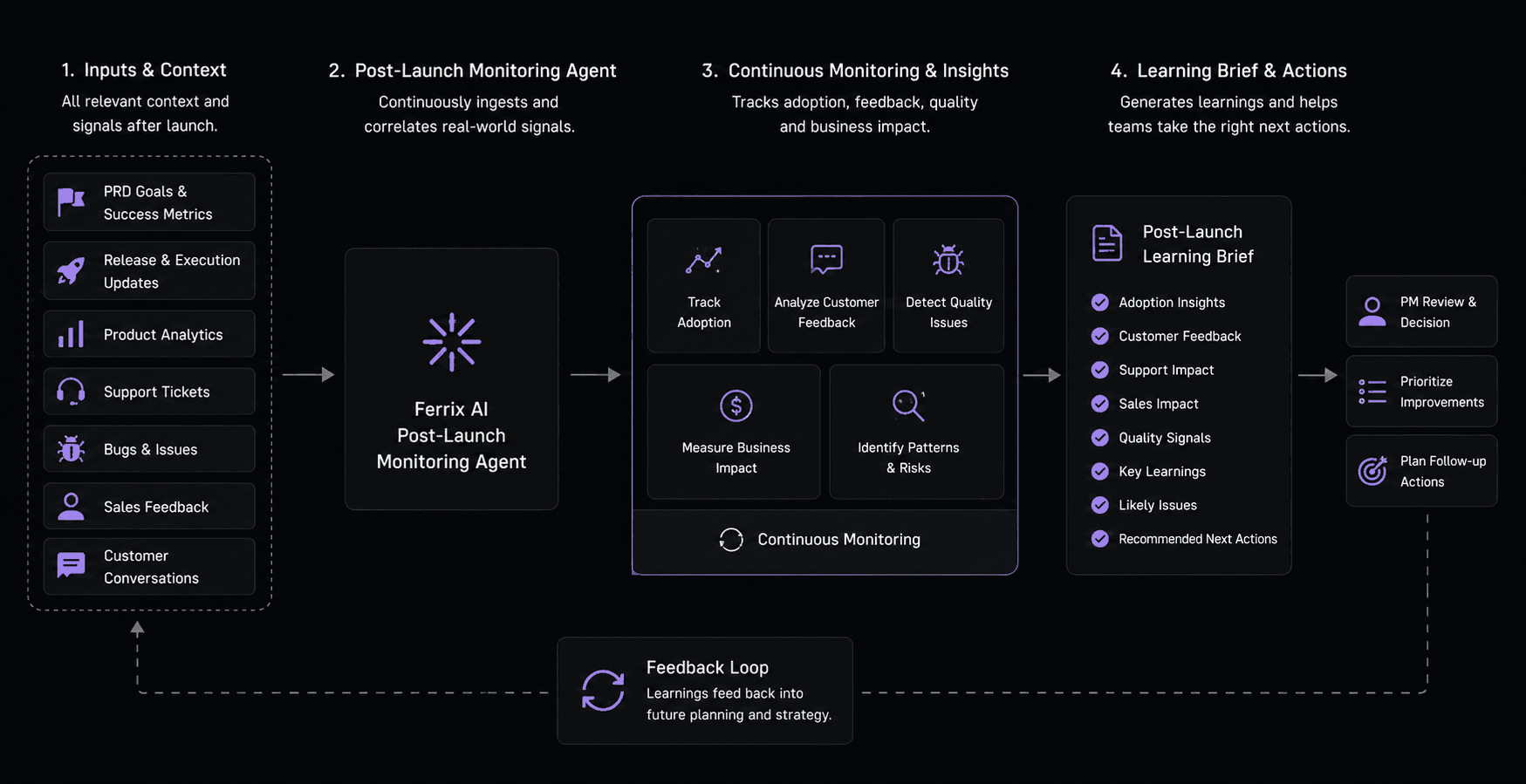
The Post-launch Monitoring Agent helps product teams understand whether the shipped feature achieved its intended outcome and what actions should happen next.
It uses context from planning, execution, and product signals to identify metrics and outcomes that need to be measured:
The PRD Generation Agent provides the original goals, success metrics, expected outcomes, and business context.
The Execution Intelligence Agent provides release status, shipped scope, implementation updates, and execution context.
Product analytics, support tickets, bugs, sales feedback, Slack discussions, and customer feedback provide real-world usage and quality signals after launch.
Using this context, a long-running agent, i.e., Post-launch Monitoring Agent, constantly monitors these signals across the identified metrics. The observations and learnings are injected back into the system to be used in future planning sessions. Also, for the PMs, the agent generates a learning brief with adoption insights, customer feedback, support impact, sales impact, quality signals, learnings, likely issues, and recommended next actions.
Product teams get continuous visibility into how the feature is performing against its original goals and customer expectations. This helps them see what is working, uncover issues early, prioritize follow-up improvements, and make better product decisions based on real customer and business outcomes.
Manual Post-Launch Tracking | Ferrix Post-Launch Monitoring Agent | |
|---|---|---|
Starting point | Scattered dashboards, tickets, and Slack threads | Connected context from PRD goals, execution updates, and live customer signals |
Signal coverage | PM checks tools one by one, often missing inputs | Continuously ingests analytics, support, sales, bugs, and customer conversations |
Evaluation | Done weeks after launch, often as a one-time review | Continuous tracking against the feature's original goals and metrics |
Output | Informal updates, ad-hoc reports, or gut-feel assessments | Structured Post-Launch Learning Brief with adoption, feedback, quality, and next actions |
Issue detection | Surfaces late, often after customer escalations | Surfaces early through pattern detection across signals |
PM effort | Hours of stitching data together every cycle | Minutes of reviewing insights and deciding next steps |
Conclusion
Ferrix AI’s Post-Launch Monitoring Agent helps teams stay connected to every release by turning adoption, feedback, support, sales, and quality signals into clear learning briefs. This gives product teams the visibility they need to understand impact, catch issues early, prioritize the right follow-ups, and make every release sharper than the last.