Bhushan Nemade
·
TL;DR
Product specs bring together user needs, flows, requirements, edge cases, and system behavior into one execution-ready document.
Writing detailed specs manually requires PMs to gather context across research, design, engineering, and analytics tools.
Ferrix AI’s Product Specification Agent transforms validated PRDs and product context into detailed specs with JTBDs, journeys, flows, requirements, and analytics events.
This helps product, design, and engineering teams stay aligned while PMs focus more on product decisions instead of documentation work.
A product spec is where ideas, discussions, and assumptions come together into a single source of truth. Every team operates in different contexts, priorities, and levels of detail. A PM has to bring all of this together into a spec that creates alignment.
The Product Specification Agent of Ferrix AI generates a clear blueprint outlining the product’s requirements, features, and functionalities, helping cross-functional teams like engineering and design move forward with confidence.
What are Product Specs?
A product spec outlines how a problem should be solved by defining the product behavior, user journey, flows, functional requirements, edge cases, and expected system responses.
While writing product specifications, teams gather requirements, define problems, and map user journeys. They also document functional behaviours, identify edge cases, and capture expected system responses in one clear reference.
A good product specification helps product, design, and engineering teams stay aligned on what is being built and why it matters. It reduces ambiguity during execution, captures important edge cases and user flows, and creates a shared understanding of expected outcomes.
How the Ferrix AI Product Specification Agent Works
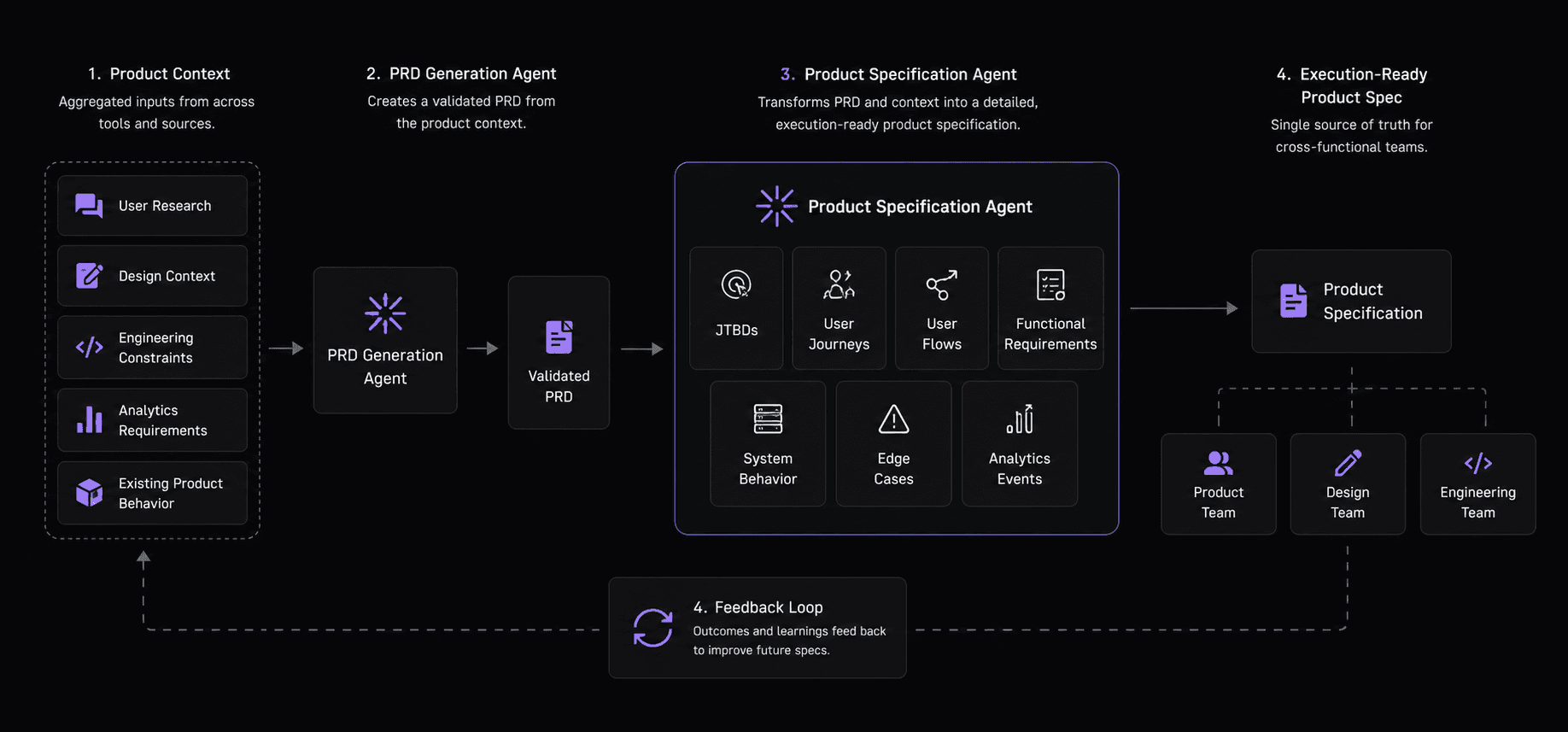
The PRD Generation Agent creates the PRD from the existing product context prepared by other Ferrix AI agents and passes both the product context and PRD to the Product Specification Agent.
Product Specification Agent transforms the PRD into a detailed execution-ready Product Spec by combining it with user research, design context, existing product behavior, engineering constraints, and analytics requirements. It generates JTBDs, user journeys, user flows, functional requirements, system behavior, edge cases, and analytics events.
As PMs, you get a clear, execution-ready Product Specification that aligns product, design, and engineering teams on user needs, expected behavior, edge cases, and success tracking. Instead of collecting and connecting context across multiple tools, you can focus on reviewing, refining, and steering the agent.
Manually Writing Specifications vs Ferrix AI’s Spec Agent
Manual or Using AI Copilots | Ferrix AI Spec Agent | |
|---|---|---|
Starting point | Starts from prompts, scattered notes, and manually collected inputs | Starts from a validated PRD and product context gathered by Ferrix AI |
Context gathering | PM manually combines research, customer feedback, design inputs, and constraints | Automatically combines PRD, research, design context, engineering constraints, and analytics requirements |
Output quality | Produces a draft that may miss edge cases, flows, or product-specific behavior | Generates detailed, execution-ready specs with JTBDs, journeys, flows, requirements, and analytics events |
PM Effort | PM spends significant time collecting context, filling gaps, and rewriting specs | PM focuses on reviewing, refining, and steering product decisions |
Conclusion
Product Specifications need more than feature lists and scattered documentation. They require connected context, clear user needs, defined system behavior, and alignment across product, design, and engineering.
Ferrix AI’s Product Specification Agent helps PMs create detailed, execution-ready specs faster by transforming PRDs and product context into structured specifications. It reduces manual effort, captures critical edge cases and flows, and helps teams move from ambiguity to aligned execution with confidence.