Bhushan Nemade
·
Once a product issue or idea is identified, product managers have to determine whether it is worth acting on. This is increasingly important as AI-assisted engineering teams ship features faster; the harder question is deciding what should be built. Yet validation remains largely manual. PMs review customer conversations, feedback, and account information to find evidence of demand and business impact. This puts product teams under pressure to make decisions quickly and can lead them to ship features before they have enough evidence.
Why Manual Product Validation Breaks Down
Validating a product idea requires qualitative evidence from customer conversations, support tickets, and sales calls, together with quantitative data from product analytics and CRM systems. In practice, these inputs sit in different tools and are rarely connected to the same issue. This makes validation slow and inconsistent.
Evidence Is Scattered and Incomplete
Customer feedback, account context, usage data, and revenue information are stored across different systems. PMs often make decisions without seeing all the available evidence.
Connecting the Evidence Takes Time
PMs must review conversations, group related feedback, identify affected customers, and compare what customers say with their product usage. Repeating this work for every idea limits how many ideas a team can properly validate.
Louder Ideas Receive More Attention
Recent escalations, repeated requests, and feedback from influential customers are easier to notice. They can receive priority even when another issue affects more customers or has greater business impact.
Ideas Are Evaluated Inconsistently
Without a shared validation process, each PM may use different criteria. One idea may be judged by request volume, another by revenue impact, and another by stakeholder urgency. This makes opportunities difficult to compare and prioritization decisions harder to explain.
How Ferrix AI Helps You Validate Product Ideas
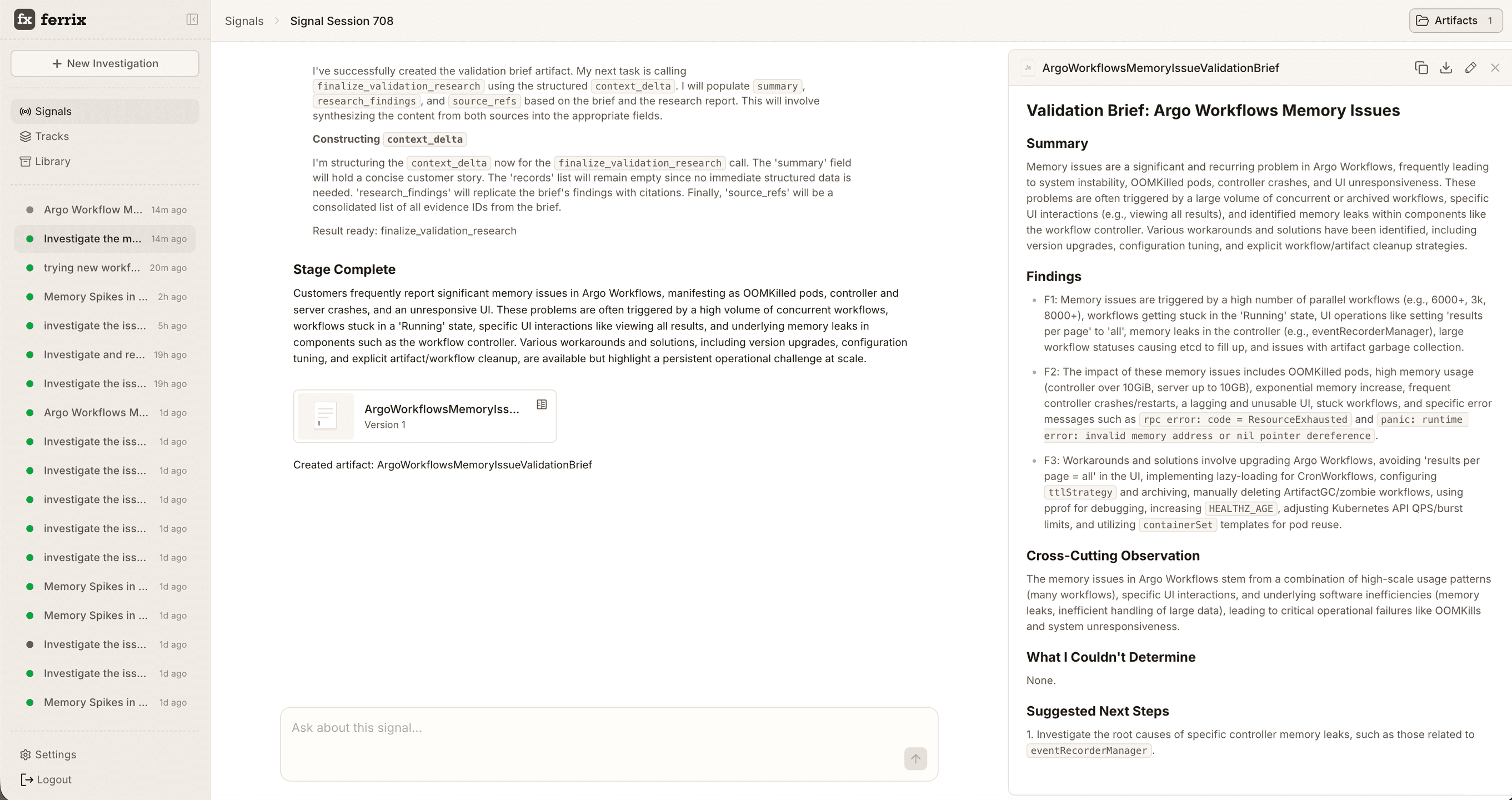
Ferrix AI provides a shared workflow between Humans and the AI agents, where Humans own the decisions and judgment, and AI agents handle the mechanical work. It connects qualitative signals, such as customer conversations and support tickets, with quantitative signals from product analytics and CRM systems. It also uses the issue context created during the product discovery stage.
The Validation Agent analyzes this combined context for each issue. It evaluates request frequency, problem severity, affected customer segments, revenue impact, and product usage patterns to determine whether an idea is supported by customer demand, business value, and strategic alignment.
The agent produces a structured validation brief containing its findings, patterns across data sources, business impact, supporting evidence, open questions, and suggested next steps. PMs review the brief, add relevant business context, and make the final prioritization decision.
From Validated Issues to Product Execution
If the supporting evidence is sufficient, the PM approves the issue and the workflow moves ahead with execution. Specialised AI agents help PMs prepare outputs such as the PRD, product specifications, and supporting documentation. The PM reviews each output, provides additional context, and controls when the work moves to the next stage.
What Changes for Product Managers
Product managers begin with a structured view of the evidence behind each idea. They receive a validation brief showing request frequency, problem severity, affected segments, product usage patterns, revenue impact, supporting evidence, and remaining questions.
The PM reviews whether the evidence is sufficient, adds business context, and makes the go/no-go decision. Ideas can be rejected, held for further validation, or moved into an execution track for PRD and specification work.
