Bhushan Nemade
·
The product feedback and customer conversations often stay scattered across support tools, documents, and individuals’ memories. Product managers have to collect and piece it together to understand what is happening and what needs attention. Because this takes time, it happens occasionally, and teams miss problems until a customer complains or leaves. By the time a clear pattern emerges, the same issue may already be affecting many customers, putting business at stake.
Why Manual Feedback Review Misses What Needs Attention
Manual review makes it hard to see the full picture. The main problems fall into four areas:
Feedback and conversations are reviewed source by source.
Product managers review each source separately and try to bring the details together manually. This makes it easy to miss important conversations leaving PMs with an incomplete picture of what needs attention.
Related issues are hard to connect
Customers often describe the same problem in different ways, as a bug, a feature request, or a comment during a call. Unless PMs connect these conversations manually, a growing issue can remain hidden across tools and accounts.
Louder voices in the room outweigh broader patterns.
When product managers cannot see broader patterns, they often rely on the feedback they hear most clearly. A persistent customer, a recent escalation, or a forceful internal request receives more attention.
Revenue or segment context is not always visible.
Feedback often lacks context about the customer’s revenue, segment, product usage, or renewal risk. Without this information, product managers cannot judge the true impact of an issue and may prioritize the wrong work.
Ferrix Issue Dashboard – The AI Agents Continuously Synthesizes your Customer Conversations to Identify and Surface What Needs Attention
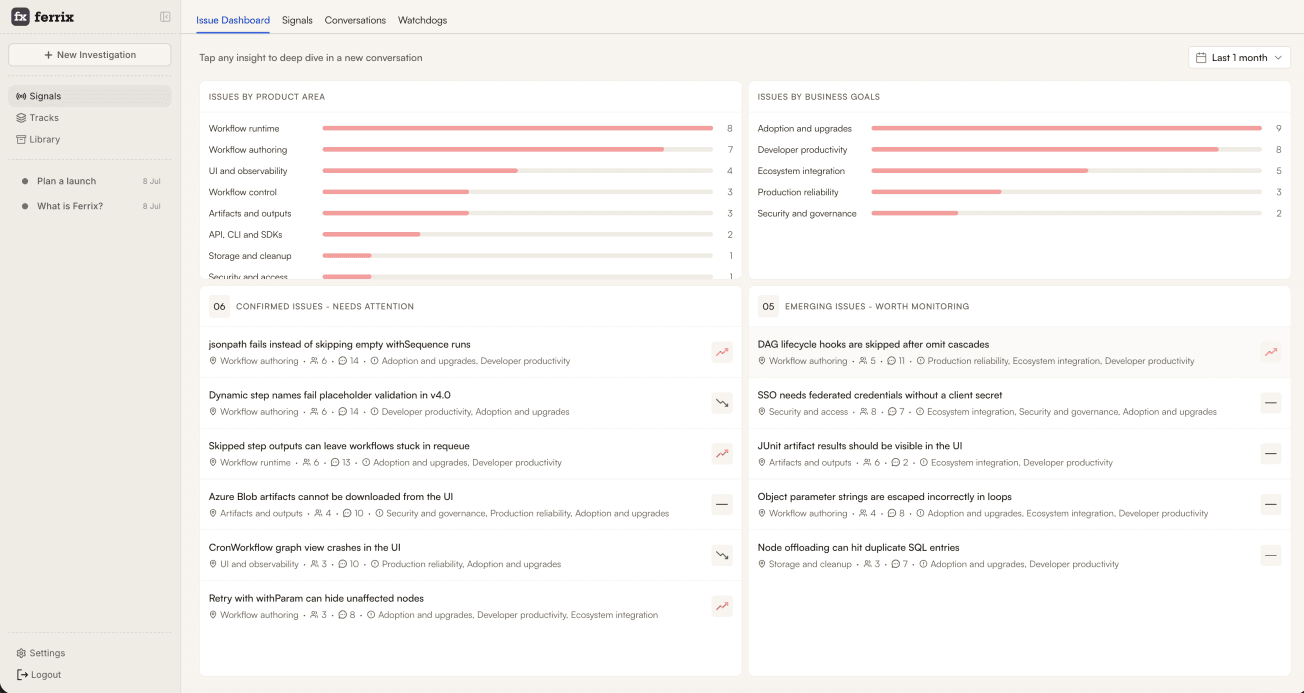
Ferrix AI provides a shared workflow between Humans and the AI agents, where Humans own the decisions and judgement, and AI agents handle the grunt work. It connects to the channels where your customer conversations already happen. The workflow starts with the product discovery agent of Ferrix; it continuously synthesises the conversation to identify “What Needs Attention”.
The Discovery Agent compares new conversations with feedback from other sources, earlier conversations, and issues the team already knows about. When it finds enough related evidence, it creates or updates an issue in the dashboard.
Each issue provides PMs a clear summary of the problem and links it to the customer conversations behind it. PMs see what customers said, how the issue has developed, and whether similar feedback has appeared before.
The agent does not decide what the team should build. It gives PMs a better place to begin.
From Identified Issues to Product Action
When an issue looks important, PMs move it forward for validation. The workflow retains the issue context from the discovery stage into the next step, where the Validation Agent starts with relevant product usage and CRM data. It then prepares a validation brief that helps answer practical questions:
Which customers face this problem?
Which customer segments does it affect?
What revenue or renewal risk is tied to the issue?
What evidence supports it?
What Changes for Product Managers
Product managers begin with a current view of customer problems and the conversations behind them. They can now spot problems earlier, before they lead to escalations or lost accounts. They can see how often an issue appears, which customers it affects, and why it matters without searching through every feedback source themselves.
Within the shared workflow, Ferrix AI handles the repeated work of finding and connecting related feedback. The PM's job shifts from doing the grunt work to applying their judgment. They assess each issue against the product strategy, add business context, weigh trade-offs, and decide what moves forward.

