Nishant Kumar
·
What is Customer Feedback?
Customer feedback is the information customers share about their experience with your product or service. It includes their insights, opinions, preferences, and complaints, everything they tell you about what's working and what isn't.
For product teams, this feedback is raw material for decision-making. It tells you where users struggle, what features they actually want, and whether your latest release solved a real problem or created new ones. Without it, you're building based on assumptions. With it, you have data to prioritise your roadmap, justify resources, and measure whether your changes had the intended effect.
The tricky part isn't collecting feedback; it's turning scattered input from dozens of sources into something actionable. That's what this guide covers.
What is a Customer Feedback Loop?
A customer feedback loop is the complete cycle of collecting, analyzing, and acting on customer feedback to improve your product or service.
The loop starts when you gather feedback from customers and closes when you show them how their input influenced your decisions. This final step, demonstrating that you listened and took action, encourages customers to continue sharing valuable insights, creating a continuous cycle of improvement.
Most teams are decent at the first half (collecting and analyzing), but they missout on closing the loop. When customers feel like their feedback goes into a black hole, they stop giving it. When they see their input reflected in product changes, they become more engaged and provide better quality feedback over time.
How the Customer Feedback Loop Works
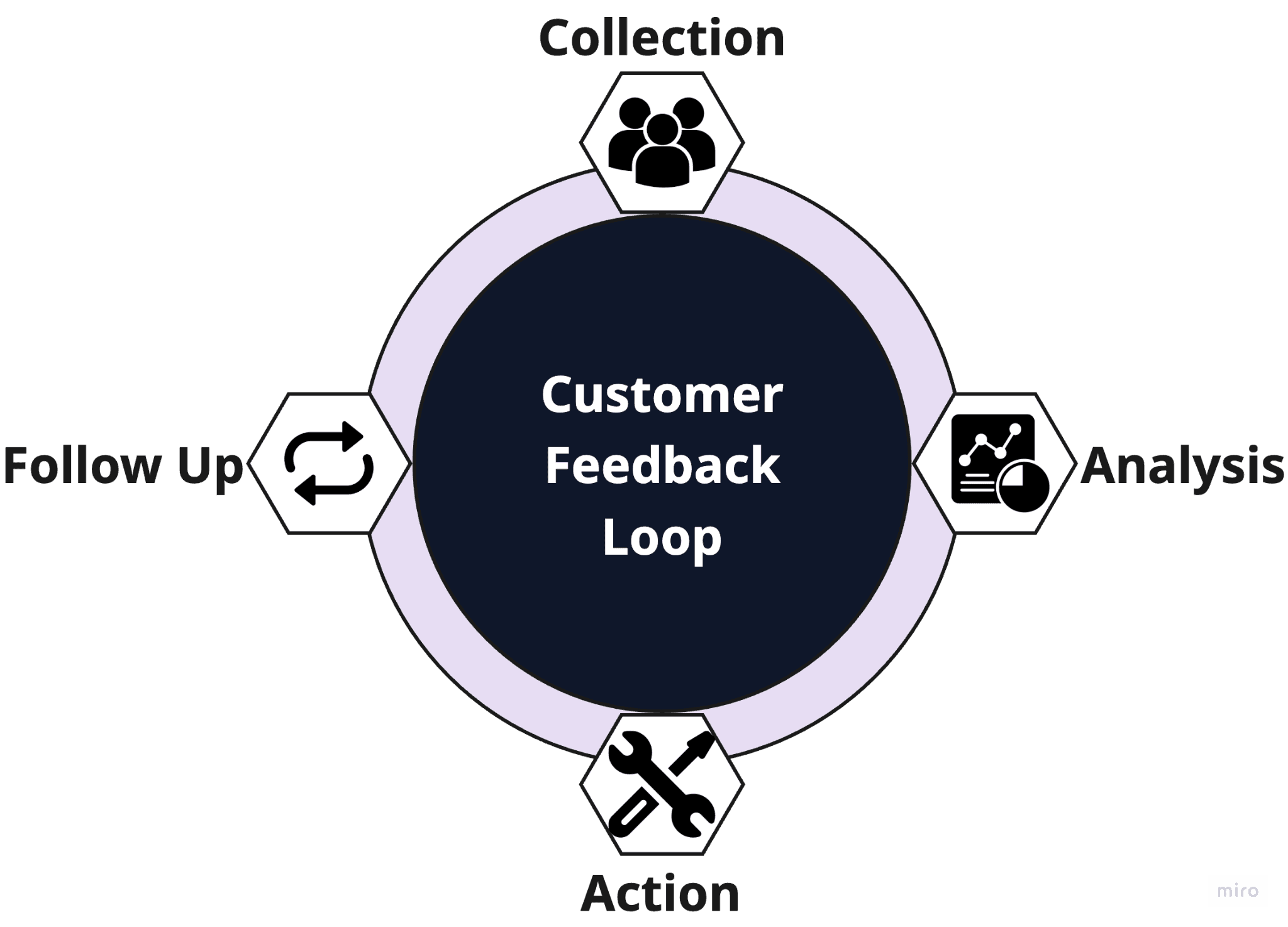
Collection – You gather feedback from multiple sources, including surveys, interviews, support tickets, reviews, and direct conversations with customers. The goal is to capture input across different touchpoints and user segments.
Analysis – The feedback is categorized and analyzed to identify patterns, priorities, and actionable insights. This is where you separate signal from noise and determine what issues affect the most users or have the highest impact on key outcomes.
Action – You implement changes or improvements based on what you learned from customer input. This might mean fixing a bug, redesigning a workflow, adding a feature, or deciding not to build something that seemed important but wasn't validated by user data.
Communication – You close the loop by informing customers about the changes you made and acknowledging their contribution. This can be as simple as a reply to an individual user or as broad as a product update email to your entire user base.
This feedback loop transforms one-time input into an ongoing dialogue with customers. When you close the loop consistently, customers see that their voices matter, which builds trust and increases their willingness to provide more detailed, constructive feedback in the future.
Why Customer Feedback Matters
Collecting and analysing customer feedback helps you understand how customers view your brand and experience your product. But beyond the general principle that "listening to users is good," there are specific, measurable reasons to invest in feedback systems.
It improves customer satisfaction in measurable ways
When you listen to feedback and actually act on it, customers notice. They feel valued. They see their opinions count for something. That responsiveness makes them happier with your product and more willing to stick around. This isn't abstract; you can track satisfaction scores before and after addressing common complaints and see the correlation directly.
It builds loyalty and reduces acquisition costs
Customers are more likely to stay loyal to brands that seek their input. When you make changes based on suggestions, it builds trust. This two-way dialogue strengthens relationships over time. Retaining customers costs significantly less than acquiring new ones, so any investment that improves retention has outsized returns.
It drives product innovation from real use cases
Your customers use your product daily in ways your team may not anticipate. They often spot opportunities for improvement that internal teams miss. Their feedback can inspire new features, point out gaps, and guide your product roadmap. Some of your best feature ideas will come directly from users who need something you haven't considered.
It helps reduce churn by catching problems early
Feedback shows early signs of dissatisfaction before it results in cancellations. By addressing issues proactively based on customer input, you can prevent customers from leaving and improve retention rates. A user who complains is giving you a chance to fix the problem; a user who churns silently never does.
It provides a competitive advantage through responsiveness
Companies that actively collect and implement customer feedback stay ahead of market needs. This responsiveness helps you differentiate from competitors who may be slower to adapt. In markets where products are similar, the company that iterates faster based on user input often wins.
Types of Customer Feedback
Customer feedback comes in different forms depending on how it's collected and what format it takes. Understanding these differences helps you select the right methods for gathering insights and interpreting the data correctly.
Quantitative Feedback
Quantitative feedback is measurable, numerical data that helps you track trends and make data-driven decisions at scale. Use it when you need clear metrics or want to understand patterns across a large customer base.
This includes product usage metrics from analytics tools like Google Analytics, Amplitude, and Posthog, as well as numerical ratings from surveys (NPS scores, CSAT ratings, star ratings). Quantitative data is useful for identifying what's happening and how widespread an issue is. It's less useful for understanding why something is happening.
Qualitative Feedback
Qualitative feedback captures customer opinions, feelings, and experiences in their own words. Unlike quantitative data, this feedback provides context and a deeper understanding of the reasoning behind user behaviour.
Gather it through open-ended questions in customer interviews, feedback forms, or observations where customers can freely express their thoughts. Qualitative feedback is harder to analyse at scale but provides the "why" behind your quantitative metrics. When your NPS drops, qualitative responses tell you the reason.
Solicited (Direct) Feedback
Solicited feedback is information you actively request from customers through intentional outreach. You control the timing, format, and questions, allowing you to gather targeted insights on specific topics or from particular customer segments.
The advantage of solicited feedback is precision; you can ask exactly what you want to know. The disadvantage is that you might be asking the wrong questions, and the act of asking can influence the responses you get.
Unsolicited (Indirect) Feedback
Unsolicited feedback comes from customers who share their opinions voluntarily, without being asked. It often reveals genuine, unfiltered perspectives since customers choose to share them on their own initiative.
Find it by monitoring public channels, analysing support interactions, and tracking social media conversations. Unsolicited feedback is valuable because it reflects what customers care about enough to bring up themselves, rather than what you prompted them to discuss. However, it's often biased toward extreme experiences, very happy or very frustrated users, and may not represent your average customer.
How to Collect Customer Feedback
Your method of collecting customer feedback should align with your goals, whether that's measuring satisfaction, uncovering product issues, or validating new ideas. To get a well-rounded view of customers, combine multiple approaches. No single method captures everything.
Customer surveys - These are structured questionnaires sent via email, in-app prompts, or web forms that gather both quantitative ratings and qualitative responses at scale. They're good for getting baseline metrics and identifying broad trends. Keep them short; survey fatigue is real, and completion rates drop significantly after 5-7 questions.
Customer interviews - These are one-on-one conversations with customers that provide deep, contextual insights into customer experiences, needs, and pain points. They're time-intensive but reveal things surveys miss. Aim for 5-10 interviews per research question; patterns usually emerge by then.
Customer focus groups - They are small group discussions that generate diverse perspectives and reveal how customers think about your product in a collaborative setting. They're useful for exploring new concepts, but can be influenced by group dynamics; dominant personalities may steer the conversation.
Social media listening - Involves actively tracking mentions, comments, and discussions across social platforms to capture unsolicited feedback and understand customer sentiment. This gives you access to authentic reactions but represents a self-selected sample of users who are active on those platforms.
Analyzing customer support tickets - Reviewing support interactions to identify recurring issues, feature requests, and friction points customers encounter regularly. This is feedback customers are already giving you; it just needs to be systematized. Tag and categorize tickets to spot patterns over time.
In-app feedback tools - These are embedded widgets or prompts that capture feedback at the moment of experience, providing immediate context about specific features or pages. The advantage is timing; you're asking about something while the user is actively engaged with it.
Best Practices for Collecting Customer Feedback
Simply sending out surveys or asking for feedback isn't enough. The quality of insights you get depends on how you collect feedback, when you ask for it, and how easy you make it for customers to respond.
Make It Easy to Leave Feedback
Customer feedback doesn't need to be lengthy, but it does need to be simple to complete. Friction kills response rates.
Use emoji reactions or star ratings that take just one click. Ask straightforward, specific questions about the product or experience. Avoid asking extraneous questions unrelated to what the customer just experienced. Use interactive elements like thumbs up/thumbs down for quick sentiment capture. Deploy short pop-up surveys immediately after key actions or interactions.
The easier the feedback mechanism, the more responses you'll get. Reserve longer surveys for situations where you genuinely need detailed responses and can offer something in return for the user's time.
Get the Timing Right
When you ask for feedback matters as much as what you ask. Catching customers at the right moment increases response rates and ensures feedback is fresh and relevant.
After a purchase captures satisfaction is captured while the experience is still top of mind. Users have just completed an action they care about and are more willing to share their thoughts.
Following a support interaction, measure resolution quality immediately after the case closes, helping you understand if you truly solved their problem.
Before churn signals means reaching out when usage drops to understand what's changed. A user who's disengaging might give you actionable feedback if you ask at the right time, and you might save the relationship.
Use Multiple Channels
Not all customers engage the same way. Some prefer email, others respond better to in-app prompts, and some are most active on social media. Diversify your approach across multiple channels to gather broader and more representative feedback.
Deploy in-app pop-ups for active users. Send email surveys for periodic check-ins. Use social media polls for broader engagement. Make phone calls for high-value accounts. Each channel reaches a different subset of your user base and provides different types of information.
Offer Incentives When Appropriate
While many customers will share quick ratings, getting detailed, thoughtful responses often requires an extra incentive. Research shows that rewards can improve response rates.
Consider gift cards or account credits for completing longer surveys, entry into prize drawings for extended feedback sessions, or early access to new features for beta testers. Match the incentive to the ask; a 30-second rating doesn't need a reward, but a 20-minute interview does.
Collect Both Qualitative and Quantitative Feedback
Numbers tell you what's happening, but words explain why. A complete feedback strategy captures both types.
Use quantitative metrics (NPS, CSAT, star ratings) to track trends and benchmark performance over time. Gather qualitative responses (open-ended questions, interviews) to understand context and motivations. Combine both to validate assumptions; if satisfaction scores drop, qualitative feedback reveals the reasons.
Neither type is sufficient alone. Quantitative data without a qualitative context leads to misinterpretation. Qualitative feedback without quantitative validation can overweight edge cases.
Acting on Customer Feedback
Gathering insights is only valuable if you translate them into meaningful action that improves your product and customer experience. This is where most teams fall short.
Connect Qualitative and Quantitative Feedback
Numbers show you what is happening, but customer voices explain why. The powerful insights come from combining both.
If quantitative data shows declining satisfaction scores, review qualitative responses to understand the specific reasons behind the drop. When qualitative feedback mentions a recurring issue, validate its scope by checking how many customers reported it in quantitative surveys. Use qualitative insights to add context to trends you spot in the numbers. This helps prioritize which issues matter most.
Example: Your NPS score drops by 10 points. Qualitative feedback reveals that customers are frustrated with a recent UI change. Together, these data points give you both the severity (quantitative) and the root cause (qualitative) needed to take action. Without the qualitative data, you'd know something was wrong, but not what. Without the quantitative data, you might dismiss the UI complaints as isolated incidents.
Understand Urgency and Quantify Impact
Not all feedback requires immediate action. Some issues affect one customer. Others affect thousands. Evaluate each piece of feedback based on how urgent it is and how many customers it affects.
Critical and widespread – Issues affecting many customers or blocking core functionality. Address them immediately.
High impact, limited scope – Problems affecting key accounts or segments. Prioritize based on strategic value.
Low urgency, broad reach – Nice-to-have improvements mentioned frequently. Add to the roadmap for future consideration.
Low urgency, narrow scope – Individual requests or edge cases. Acknowledge but deprioritize.
You can't fix everything at once. Prioritize ruthlessly.
Connect Feedback to Your Product Roadmap
Customer feedback shouldn't live in isolation. It should inform and shape your product development priorities.
Map feedback themes to existing roadmap items to validate or adjust priorities. Create a feedback-driven backlog where highly requested features are tracked alongside strategic initiatives. Include customer quotes and data in roadmap planning sessions to keep the team grounded in real user needs. Update roadmap priorities quarterly based on evolving feedback trends.
Example: Multiple customers request better reporting capabilities. Rather than building a generic solution, review the specific use cases mentioned in qualitative feedback to design features that address real workflows.
Close the Loop with Customers
The final, and often forgotten, step is telling customers what you did with their feedback. Closing the loop shows customers their input matters and encourages them to continue sharing insights.
For individual feedback: Reply directly to customers who submitted suggestions, even if you can't implement their idea. Explain your decision and thank them for the input.
For widespread issues: Send product update emails highlighting changes made based on customer requests. Include specific examples of feedback that influenced the decision.
Through regular updates: Maintain a public changelog or "You asked, we delivered" section showing improvements driven by customer feedback.
When customers see their feedback lead to real changes, they keep talking to you. When feedback disappears into a black hole, they stop sharing.
Conclusion
Customer feedback is how you learn what customers actually need, not what you assume they need. It's the difference between building products based on evidence and building products based on hunches.
The companies that win are the ones that listen systematically. They collect feedback through multiple channels. They analyze it to find patterns. They act on what they learn. And they close the loop by showing customers their input mattered.
Start simple. Pick one feedback method and use it consistently. Build the habit of listening. Then expand from there.
Your customers are already telling you what they want. The question is whether you're paying attention.