Nishant Kumar
·
Product management follows a recurring loop across teams and companies, though its shape and rhythm vary with context.
Signals → Initiatives → Planning → Execution → Artifacts → Knowledge Base → Signals again.
Every product team runs some version of this loop. The problem isn’t that the structure doesn’t exist. It’s that we don’t make it explicit, and we don’t have systems that support it end-to-end. Each phase lives in a different tool, and the connective tissue is you—copying context, holding mental models, stitching everything together.
The result is messy execution. Once you're in it, stepping back to check whether what you're building still connects to the signals that started it feels like a luxury. Context leaks between phases. Decisions get made without the benefit of prior cycles. The loop exists, but it runs on memory and manual effort. Both break under load.
The Ideal Product Flow
Here’s the ideal loop and what breaks at each phase when it’s held together by people instead of a system.
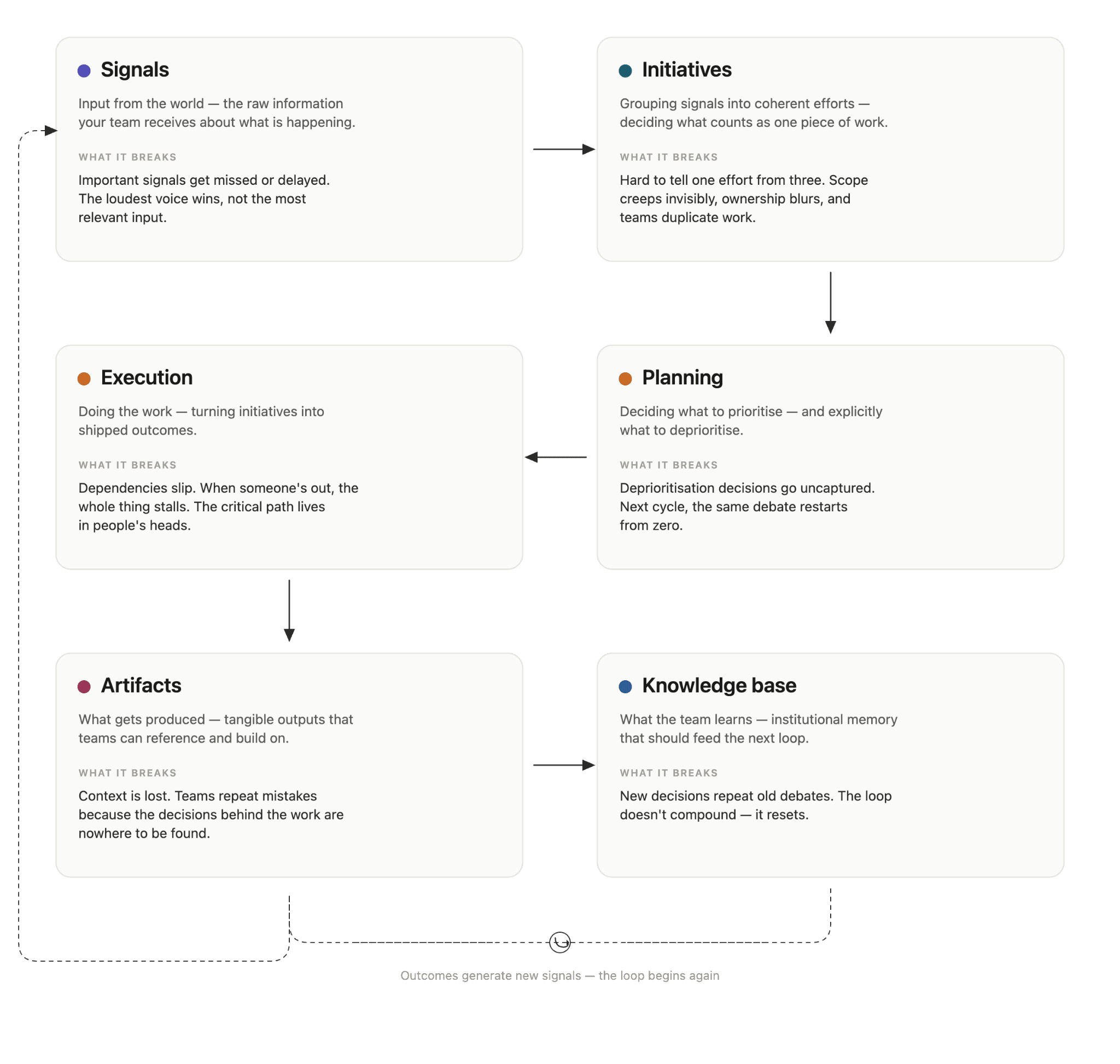
The Problem Today
Every PM runs this loop. Almost nobody runs it as a system.
Signals live across support queues, analytics dashboards, CRMs, and sales call notes, but rarely get unified into a single view of reality. Initiatives are defined in one place, planned in another, executed in a third, with context thinning at every handoff. Artifacts get created and buried. Knowledge accumulates informally in people’s heads and leaves when they do.
The infrastructure to support the loop is missing. So the loop runs on the PM’s attention, memory, and constant manual effort to stitch everything together. That isn’t product management. It’s project administration.
Step 1: Give it Structure
The loop is already there. The first step is to make it explicit.
Making it explicit means creating traceability across phases so that the flow of work is connected, not fragmented. An initiative can be traced back to the signal that triggered it. Planning decisions capture not just outcomes, but the trade-offs behind them. Artifacts carry the context of why they exist and what they were meant to achieve. Knowledge is organized around the work that produced it, rather than around whoever happened to store it.
When those links exist, the nature of the work changes. You can follow decisions back to their origin. You can understand why something was built without relying on memory. Knowledge doesn’t decay, it compounds.
This isn’t about adding process. It’s about removing the need to carry the entire product story in your head. In practice, this often means introducing a shared structure—a system layer or data model that connects signals, decisions, and outcomes across tools.
Once the loop is structured, something important becomes possible: parts of it can be delegated.
Step 2: Enter the Agentic Era
Structure is what makes delegation viable.
Without it, AI tools generate outputs without grounding. With it, they can operate over a coherent system of context, decisions, and history. The parts of the loop that are repetitive, data-heavy, and pattern-based, the work that consumes most of a PM’s time, become delegable.
Signals can be continuously aggregated across sources, with patterns surfaced without manual triage. Initiatives can be suggested based on recurring themes and signal clusters. Prioritization can be informed by consistent views of impact, effort, and constraints. Specs, summaries, and decision records can be drafted from the existing context instead of being recreated each time. Artifacts can be organized automatically, with outcomes linked back to the decisions and signals that produced them.
The shift is not that the system replaces the PM. It’s that it assembles the picture.
Instead of spending hours reconstructing context, you start with it. Monday morning, the trends are already surfaced, the anomalies already flagged, and related signals already grouped. You don’t spend time gathering the inputs. You spend time deciding what to do about them.
PMs move from assembling the work to deciding the outcome.
Step 3: Define Agent Responsibility
Not everything in the loop should be delegated in the same way.
There is a natural boundary in the work. Some parts are mechanical, collecting signals, organizing information, surfacing patterns, drafting first versions, and maintaining structure. These benefit from consistency and scale. Other parts are judgment-driven interpreting context, making trade-offs competing priorities, deciding under uncertainty, and taking accountability for outcomes.
That boundary isn’t fixed. It shifts as systems improve and as trust builds over time. But the principle remains stable: the system gathers and structures the world; the PM decides what it means and what to do next.
Step 4: Acknowledge the Risks
This only works if the failure modes are explicit.
A system that automates too aggressively will act where it shouldn’t. A system that produces clean outputs can create blind trust, where decisions are accepted without scrutiny. A system that lacks transparency makes recommendations that can’t be evaluated. And when actions are taken automatically, some of them will be hard or impossible to reverse. Underneath all of this is a more fundamental risk: poor or incomplete data leading to confident but wrong conclusions.
Autonomy doesn’t emerge safely by default. It has to be designed with boundaries.
Step 5: Calibrated Autonomy
The answer isn't AI on or off. It's a spectrum, governed by two dimensions: risk and reversibility.
| Low Risk | High Risk |
|---|---|---|
Reversible | Auto-advance. Undo available. | Recommend + show consequences. You approve. |
Irreversible | Lightweight checkpoint. You confirm. | Full stop. Full reasoning. You decide. |
But this matrix is static. The missing dimension is earned trust—the system learns from your behavior, adapts over time, and gradually takes on more autonomy you're comfortable with.
Your Behavior | System Response |
|---|---|
Approve consistently | Earns more autonomy, auto-advances more |
Inspect deeply on certain topics | Surfaces more detail there by default |
Override frequently | Pulls back, asks more, waits for approval |
Autonomy that's granular, contextual, and earned over time. Not a switch you flip.
The Shift
Today, many PMs spend most of their time managing tools, writing documents, and chasing updates.
When the loop is explicit, the mechanical work is delegated, and autonomy is intentionally designed, the role shifts. The focus moves away from assembling information and toward interpreting it. Away from coordinating work and toward deciding what matters.
The Vision
Product management isn’t about managing work. It’s about sensing reality, deciding what matters, and turning it into knowledge that compounds.
The future system doesn’t just help PMs move faster. It holds the loop so they can focus on the judgment the loop exists to serve.